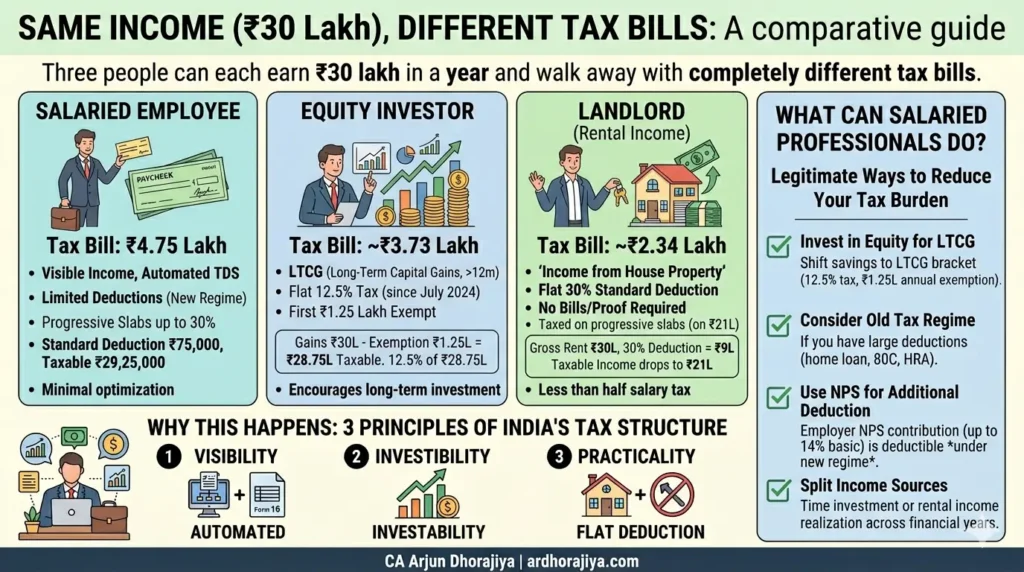
Three people can each earn ₹30 lakh in a year and walk away with completely different tax bills. A salaried employee might pay ₹4.75 lakh in tax, an equity investor pays around ₹3.73 lakh, and a landlord pays just ₹2.34 lakh – on the exact same income. This article breaks down why this happens, explains the tax rules behind each income type, and shows what salaried professionals can do to reduce their tax burden legally.
Tax Comparison at a Glance: ₹30 Lakh Income
Income Type | Gross Income | Tax Payable | Effective Rate | |
Salaried Employee | ₹30,00,000 | ₹29,25,000 | ₹4,75,800 | ~15.9% |
Equity Investor (LTCG) | ₹30,00,000 | ₹28,75,000 | ₹3,73,750 | ~12.5% |
Landlord (Rental Income) | ₹30,00,000 | ₹21,00,000 | ₹2,34,000 | ~7.8% |
Note: Calculations above are illustrative estimates for FY 2025-26 under the new tax regime. Actual tax may vary based on individual circumstances.
How Is a Salaried Employee Taxed?
Salaried income is the most straightforward and the most heavily taxed – type of income in India. Every rupee you earn is visible, reported by your employer, and subject to TDS (Tax Deducted at Source) before the money even reaches your bank account.
Under the new tax regime for FY 2025-26, a salaried individual earning ₹30 lakh gets a standard deduction of ₹75,000, leaving taxable income of ₹29,25,000. Tax is then calculated at progressive slab rates – from 5% on the lower slabs all the way up to 30% on income above ₹15 lakh.
There are very few deductions available under the new regime. No 80C, no HRA, no LTA. The result is a tax bill that offers little room for optimization.
How Are Equity Investors Taxed on Long-Term Capital Gains?
When you sell listed shares or equity mutual fund units after holding them for more than 12 months, the profit is called Long-Term Capital Gain (LTCG). Since July 2024, LTCG on equity is taxed at a flat 12.5% – well below the 30% slab rate applied to the highest bracket of salary income.
The first ₹1.25 lakh of LTCG each year is exempt from tax. So on ₹30 lakh of gains, only ₹28,75,000 is taxable, resulting in a tax bill of approximately ₹3,73,750. That is about ₹1 lakh less than what a salaried employee pays on the same gross income.
The rationale from the government is simple: lower tax on capital gains encourages long-term investment in stock markets, which supports economic growth.
How Are Landlords Taxed on Rental Income?
Rental income falls under the tax head ‘Income from House Property.’ India’s income tax law gives landlords a flat 30% standard deduction on net rental income – no bills, no receipts, no proof required. This deduction is given regardless of actual expenses.
On a gross rent of ₹30 lakh, after municipal taxes, the net value is roughly ₹30 lakh (assuming negligible municipal taxes here for simplicity). After applying the 30% standard deduction, taxable income drops to ₹21 lakh. Tax on ₹21 lakh at progressive slab rates comes to approximately ₹2,34,000.
This is less than half of what a salaried employee pays. The 30% deduction exists because tracking every maintenance expense, repair cost, or vacancy loss is practically impossible for the tax department.
Why Does the Tax System Work This Way?
This is not a loophole or an oversight. The income tax structure in India is deliberately designed around three principles:
- Visibility: Salary income is the easiest to track. Employers file TDS returns, Form 16 is issued, and the entire chain is automated.
- Investibility: Lower taxes on capital gains are a policy tool to attract investors into equity and real estate markets.
- Practicality: A flat 30% deduction on rent exists because the government cannot verify every landlord’s actual expenses across crores of properties.
The salaried class ends up paying more not because the system is unfair to them by design, but because their income leaves no room for ambiguity and very little room for planning.
What Can Salaried Employees Do About It?
While salaried income itself has limited flexibility, there are legitimate ways to reduce your overall tax liability:
1. Invest in Equity for Long-Term Gains
Channelling savings into equity mutual funds or direct stocks held for more than a year shifts future income into the LTCG bracket, taxed at just 12.5% with a ₹1.25 lakh annual exemption.
2. Consider the Old Tax Regime If You Have Deductions
If you pay home loan interest, make 80C investments, and receive HRA, the old regime can significantly reduce your taxable income. Run a comparison before filing each year.
3. Use NPS for Additional Deduction
Under the new regime, employer contributions to NPS up to 14% of basic salary are deductible. This is one of the few structured tax benefits available in the new regime.
4. Split Income Sources Over Time
If you have a rental property or investments, timing their realization across financial years can help avoid higher tax brackets.
Conclusion
Three people earning ₹30 lakh a year will pay three very different amounts in income tax depending on how they earn that money. A salaried employee pays close to ₹4.76 lakh, an equity investor pays around ₹3.74 lakh, and a landlord pays roughly ₹2.34 lakh. The difference is not accidental – it reflects deliberate policy choices around visibility, investment incentives, and administrative practicality. If you are salaried, the best you can do is understand these rules and use legitimate tools like equity investing, NPS contributions, and tax regime selection to reduce your burden. Knowledge of the tax code is the first and most powerful step toward keeping more of what you earn.
You can call or whatsapp at +91 9769647582 for any ITR filing query or service.
Frequently Asked Questions
Is it legal to pay less tax through rental income or capital gains?
Yes, completely. Tax rules for rental income and capital gains are part of the Income Tax Act, 1961. Using these provisions is legitimate tax planning, not evasion.
Can a salaried employee also earn LTCG?
Absolutely. A salaried person who invests in equity funds or stocks for over a year will have LTCG taxed at the flat 12.5% rate, separate from their salary income.
What is the standard deduction for salaried employees in FY 2025-26?
Under the new tax regime, the standard deduction for salaried individuals is ₹75,000. This is the only automatic deduction available without submitting any proof.
Why is the 30% deduction on rental income allowed without proof?
The 30% deduction under Section 24 is a statutory allowance. The government recognized that verifying actual maintenance, repair, and vacancy expenses across millions of properties is impractical, so a flat deduction was built into the law.
—
This article is for informational purposes only and does not constitute financial or tax advice. Please consult a qualified CA or tax advisor for your specific situation.
Serving across india
- Income tax
- GST
- Business registration
- Accounting
- Audit
- ROC filings
- Certificates
- Project report or CMA data