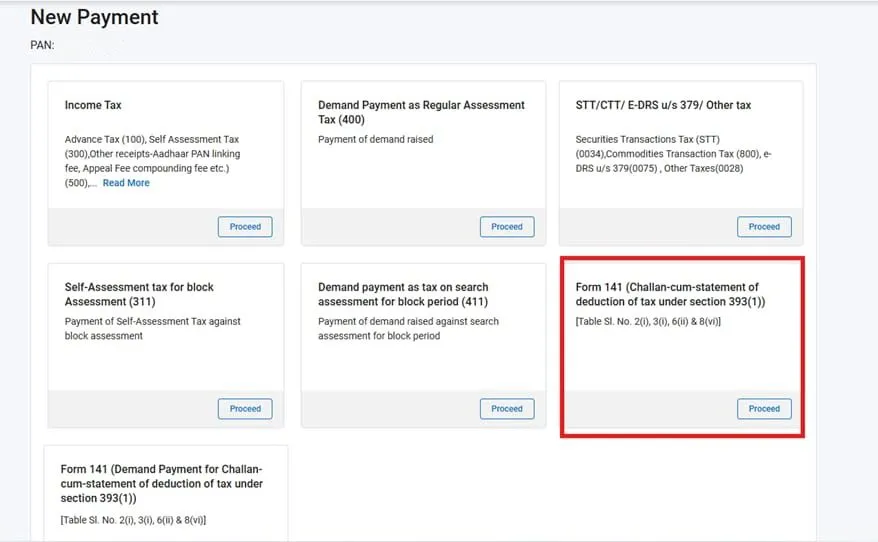
From 1 April 2026, the Income Tax Department has introduced a major change in how TDS payments are made for property purchases, rent, and certain other specified transactions. A single new form – Form 141 – now replaces the four separate forms that taxpayers previously had to deal with: 26QB, 26QC, 26QD, and 26QE. This article explains what Form 141 is, who needs to file it, how it works, and what steps you need to follow on the income tax portal.
Key Facts at a Glance
Detail | Information |
Effective Date | 1 April 2026 |
New Form | Form No. 141 (Challan-cum-Statement) |
Governing Section | Section 393(1) of the Income Tax Act, 2025 |
Forms Replaced | 26QB, 26QC, 26QD, 26QE |
Filing Deadline | Within 30 days from the end of the month of deduction |
Filing Mode | Online – Income Tax Portal (incometax.gov.in) |
Applicable To | Transactions on or after 1 April 2026 (Tax Year 2026-27) |
What Is Form 141?
Form 141 is a PAN-based Challan-cum-Statement introduced under the Income Tax Rules 2026. It is used to report and deposit TDS for specific types of transactions that do not go through the regular quarterly TDS return process.
The earlier system required separate forms for different types of payments – which meant multiple filings, multiple challans, and a lot of confusion. Form 141 brings all of these under one roof, making TDS compliance significantly simpler.
Which Forms Does Form 141 Replace?
Here is a quick look at the old forms and the transactions they covered:
Old Form | Transaction Type | Old Section (IT Act 1961) |
26QB | Purchase of immovable property (Rs. 50 lakh or more) | Section 194-IA |
26QC | Rent paid by individual/HUF (above Rs. 50,000/month) | Section 194-IB |
26QD | Payments to contractors/professionals by individual/HUF (above Rs. 50 lakh) | Section 194M |
26QE | Transfer of virtual digital assets (crypto) | Section 194S |
All four of these are now covered by Form 141 under Section 393(1) of the Income Tax Act, 2025, through dedicated schedules (Schedule A, B, C, and D).
Who Needs to File Form 141?
You need to file Form 141 if you are an individual, HUF, or any other person responsible for deducting TDS in the following situations:
- You bought an immovable property worth Rs. 50 lakh or more
- You are an individual or HUF paying rent of more than Rs. 50,000 per month (non-business)
- You are an individual or HUF paying contractors, professionals, commission agents, or brokers exceeding Rs. 50 lakh in a year
- You are involved in a transaction related to transfer of virtual digital assets (crypto)
Important: Form 141 applies to transactions that occur on or after 1 April 2026 (Tax Year 2026-27). For earlier transactions, the old forms (26QB, 26QC, etc.) continue to apply. If you are filing a correction or revised TDS return for a quarter ending on or before 31 March 2026, you must still use the old forms. |
How to File Form 141 – Step-by-Step Process
Filing Form 141 is done entirely online through the official Income Tax Portal. Here are the steps:
- Log in to the Income Tax Portal at incometax.gov.in using your PAN and password.
- On the homepage, navigate to E-file > E-Pay Tax > ‘Income Tax Act 2025’ section.
- Select the ‘New Payment’ option.
- Choose Form 141 – Challan-cum-Statement u/s 393(1).
- Select the applicable Schedule (A for rent, B for property, C for professional/contract payments, D for VDA/Crypto).
- Fill in the required details – deductee PAN, amount paid, TDS deducted, date of deduction, any other relevant details as required under various Schedule.
- Make the TDS payment online. The due date is within 30 days from the end of the month in which TDS was deducted.
Understanding the Schedules Within Form 141
Form 141 is structured into multiple schedules so that each transaction type is reported separately within the same form:
Schedule | Transaction | TDS Rate (General) |
Schedule A | Rent > Rs. 50,000/month by Individual/HUF | 2% (earlier 5% u/s 194-IB) |
Schedule B | Transfer of immovable property (Rs. 50 lakh+) | 1% |
Schedule C | Contractor/professional/commission by Individual/HUF | 2% |
Schedule D | Transfer of Virtual Digital Assets | 1% |
Key Takeaways for Taxpayers
- Form 141 is mandatory for all specified TDS transactions from 1 April 2026 onwards – the old forms are no longer valid for new transactions.
- The transition to the Income Tax Act, 2025 does not change the fundamental TDS obligations – only the form numbers and the filing structure.
- The TRACES portal and e-TDS utilities will support both old and new formats during the transition period. Old forms still apply for corrections related to periods up to March 2026.
- Always deduct TDS on the actual payment amount, excluding GST. For property purchases, also include ancillary charges like parking and maintenance fees.
- Each buyer and each seller in a joint property transaction must be separately reported within Form 141 – but you now file a single form instead of multiple challans.
- Keep the TDS certificate (Form 16B or equivalent under the new rules) ready, as the deductee will need it to claim credit in their ITR.
Conclusion
Form 141 is a welcome step toward simplifying TDS compliance in India. By merging four separate forms – 26QB, 26QC, 26QD, and 26QE – into a single, structured challan-cum-statement, the Income Tax Department has reduced paperwork and made the process more intuitive for individual taxpayers. The key things to remember: Form 141 is applicable for all specified PAN-based TDS transactions from 1 April 2026, it must be filed within 30 days from the end of the deduction month, and it is available on the Income Tax Portal under the Income Tax Act 2025 section. Stay updated with notifications from the CBDT and consult a tax professional if you have transaction-specific queries.
You can Call or Whatsapp us at +91 9769647582 for any query or TDS filing requirement.
Serving across india
- Income tax
- GST
- Business registration
- Accounting
- Audit
- ROC filings
- Certificates
- Project report or CMA data