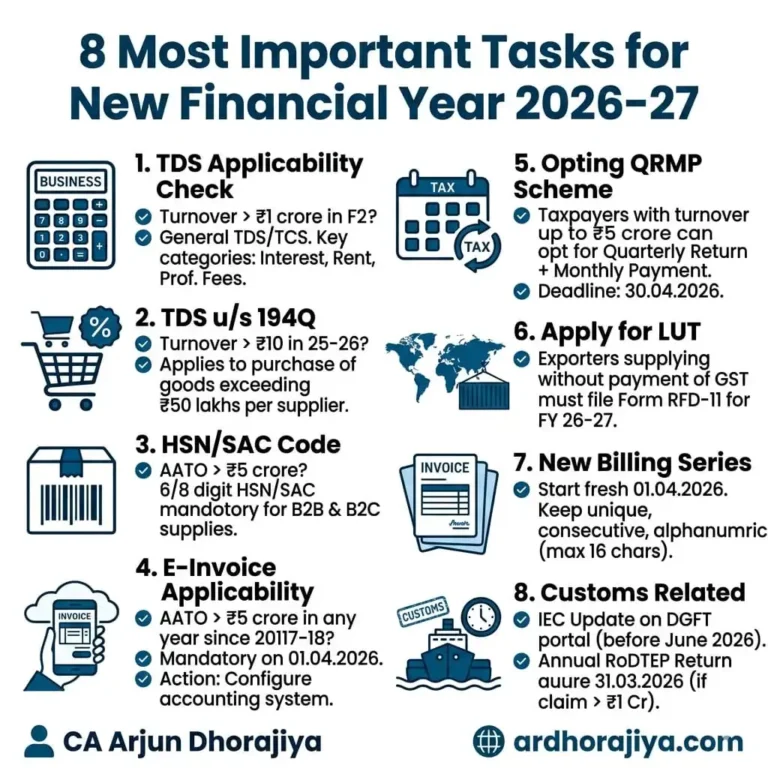
The start of a new financial year is one of the most important compliance windows for businesses, professionals, and exporters in India. For FY 2026-27, starting 01 April 2026, several key thresholds, rules, and filing requirements are refreshed – from TDS applicability and GST e-invoicing to fresh invoice series and IEC updates. Missing even one deadline can attract penalties, disrupt operations, or trigger notices from the tax department. This guide walks you through the 8 most critical tasks every business must complete at the start of FY 2026-27.
Quick Compliance Checklist: FY 2026-27
# | Task | Threshold / Trigger | Deadline |
1 | General TDS/TCS Deduction | Turnover > Rs.1 Cr (Individual/HUF) | 01 April 2026 |
2 | TDS u/s 194Q on Purchase of Goods | Turnover > Rs.10 Cr | 01 April 2026 |
3 | 6/8-Digit HSN/SAC Code on Invoices | AATO > Rs.5 Cr | 01 April 2026 |
4 | E-Invoice Generation (GST) | Turnover > Rs.5 Cr (any FY from 2017-18) | 01 April 2026 |
5 | Opt for QRMP Scheme (GST) | Turnover up to Rs.5 Cr | 30 April 2026 |
6 | File LUT for Exporters (RFD-11) | All zero-rated supply exporters | Before first export |
7 | Start New Invoice / Billing Series | All registered taxpayers | 01 April 2026 |
8 | IEC Update & RoDTEP Annual Return | All exporters with IEC | Before June 2026 |
1. Review Last Year’s Turnover for General TDS/TCS Applicability
If your turnover in FY 2025-26 crossed Rs.1 crore as an Individual or HUF running a business, general TDS provisions become mandatory from 01 April 2026. Partnerships, companies, and LLPs must deduct TDS irrespective of their turnover. This is not optional.
Common expenses on which TDS must now be deducted include:
- Interest, rent, and commission payments
- Contractor payments under Section 194C
- Professional and technical fees (Section 194J)
- Advertisement, freight, and shipping charges
- Job work, repairs, and labour contracts
Key point: The threshold is based on turnover in FY 2025-26, not the current year. Even if you did not require a tax audit, TDS applies once turnover crosses Rs.1 crore.
2. Check if TDS u/s 194Q Applies to Your Purchases
Section 194Q mandates TDS deduction on the purchase of goods if your turnover in FY 2025-26 exceeded Rs.10 crore. From 01 April 2026, you must deduct 0.1% TDS on purchases from any single supplier where the annual purchase value exceeds Rs.50 lakhs.
Practical tip: Build a supplier-wise tracker at the start of the year. Once purchases from a supplier cross Rs.50 lakhs in FY 2026-27, TDS deduction kicks in on the amount above that threshold.
3. Ensure Correct HSN/SAC Codes on All Invoices
If your Annual Aggregate Turnover (AATO) exceeds Rs.5 crore, you must use 6-digit or 8-digit HSN/SAC codes on all supply invoices – both B2B and B2C – starting 01 April 2026. Using 4-digit codes will no longer be sufficient.
This applies to both goods (HSN) and services (SAC). Verify your accounting software or ERP is configured to auto-populate the correct digit-length code before you raise the first invoice of the new year.
4. Set Up and Activate E-Invoicing If Your Turnover Exceeds Rs.5 Crore
E-invoicing is mandatory from 01 April 2026 for businesses whose aggregate turnover in any financial year from FY 2017-18 onwards has exceeded Rs.5 crore.
Steps to Set Up E-Invoicing Before 1 April 2026:
- Configure your accounting system or ERP for IRP (Invoice Registration Portal) integration
- Generate and save your API credentials from the GST portal
- Do a test run to ensure IRN (Invoice Reference Number) is generated correctly
- Train your accounts team to handle QR codes and IRN on invoices
Warning: Invoices issued without IRN where e-invoicing is mandatory are treated as invalid under GST. This can affect input tax credit for your buyers.
5. Opt Into (or Out of) the QRMP Scheme by 30 April 2026
The QRMP (Quarterly Return Monthly Payment) scheme is available for GST registered taxpayers with turnover up to Rs.5 crore. Under this scheme, GSTR-1 and GSTR-3B are filed quarterly, while tax is paid monthly using a simplified challan.
The window to opt in or opt out of QRMP for April to June Quarter closes on 30 April 2026. Review your cash flow patterns and compliance capacity before making this decision. If you prefer filing monthly and want better ITC reconciliation control, staying in the regular monthly scheme may suit you better.
6. File LUT (Form GST RFD-11) if You Are an Exporter
Exporters who supply goods or services without payment of IGST must file a Letter of Undertaking (LUT) for FY 2026-27 before making the first zero-rated supply. The form to file is GST RFD-11, available on the GST portal.
This applies to:
- Exports of goods and services without GST payment
- Supplies to Special Economic Zones (SEZ units and developers)
Without a valid LUT, you either have to pay IGST upfront (and claim a refund later). Filing a fresh LUT at the start of every financial year avoids unnecessary cash flow blocks.
7. Start a New Invoice Numbering Series from 1 April 2026
Every registered taxpayer must begin a fresh invoice series at the start of each financial year. This applies to:
- Tax invoices (B2B and B2C)
- Debit notes and credit notes
- Bills of supply
GST Invoice Numbering Rules to Follow:
Rule | Requirement |
Format | Alphanumeric characters allowed |
Maximum Length | 16 characters |
Sequence | Must be unique and consecutive |
Series Reset | Mandatory at start of each FY |
E-Invoice Note | E-invoice setup must be done before issuing first invoice if applicable |
8. Complete Customs Compliance: IEC Update and RoDTEP Annual Return
Two important customs-related compliance tasks require immediate attention at the start of FY 2026-27:
IEC Update on the DGFT Portal
All businesses holding an Importer Exporter Code (IEC) must update their IEC details on the DGFT portal before June 2026. This is a mandatory annual exercise. Failure to update may result in the IEC being deactivated, which can disrupt exports and imports.
RoDTEP Annual Return (ARR)
Exporters who claimed RoDTEP benefits of more than Rs.1 crore in FY 2023-24 are required to file the Annual RoDTEP Return. The due date was 31 March 2026, but a grace period of 3 months is available with a fee of Rs.15,000. If you missed the deadline, file immediately to avoid further consequences.
Key Takeaways: New Financial Year Compliance Summary
- Review last year’s turnover immediately – TDS and GST obligations depend on FY 2025-26 figures
- Set up e-invoicing before raising the first invoice of April 2026 if your turnover crosses Rs.5 crore
- File LUT on the GST portal before your first export of FY 2026-27
- Reset your invoice numbering series on 01 April 2026
- Opt in or out of QRMP before 30 April 2026
- Update your IEC on DGFT and file the RoDTEP Annual Return if applicable
Conclusion
Starting FY 2026-27 on the right compliance footing can save your business from penalties, notices, and operational disruptions. The eight tasks covered in this article – from TDS applicability checks and e-invoice setup to LUT filing, fresh invoice series, and IEC updates – are not optional formalities. They are core legal obligations that trigger on 01 April 2026 or shortly after.
The best approach is to complete these tasks in the first week of April itself, before operational routines take over. Consult your CA if you are unsure about which thresholds apply to your specific business structure.
You can Call or Whatsapp us at +91 9769647582 for any query or GST filing requirement.
Frequently Asked Questions (FAQs)
Q1. Is TDS applicable if my turnover is Rs.1 crore but I am not required to get my accounts audited?
Yes. The TDS threshold of Rs.1 crore for Individuals and HUFs is linked to business turnover, not audit applicability. Even without an audit obligation, TDS provisions apply once turnover crosses Rs.1 crore.
Q2. Do I need to file a fresh LUT every year even if I already filed one last year?
Yes. An LUT filed for FY 2025-26 is not valid for FY 2026-27. You must file a fresh Form GST RFD-11 on the GST portal for every financial year before making zero-rated supplies.
Q3. What happens if I issue invoices without IRN where e-invoicing is mandatory?
Such invoices are considered invalid under GST law. The buyer may lose the right to claim Input Tax Credit on those purchases, and you may face penalties and notices from the GST department.
Q4. Can I still opt for QRMP after 30 April 2026?
No. The window to opt in or out of the QRMP scheme for April to June Quarter closes on 30 April 2026. After this date, your existing filing frequency will continue for the rest of the year which can be updated again every quarter if required.
Q5. What is the penalty for not updating IEC on the DGFT portal?
Failure to update your IEC can lead to deactivation of the code. A deactivated IEC will block customs clearances for both imports and exports until the update is completed and the IEC is reactivated.
Serving across india
- Income tax
- GST
- Business registration
- Accounting
- Audit
- ROC filings
- Certificates
- Project report or CMA data