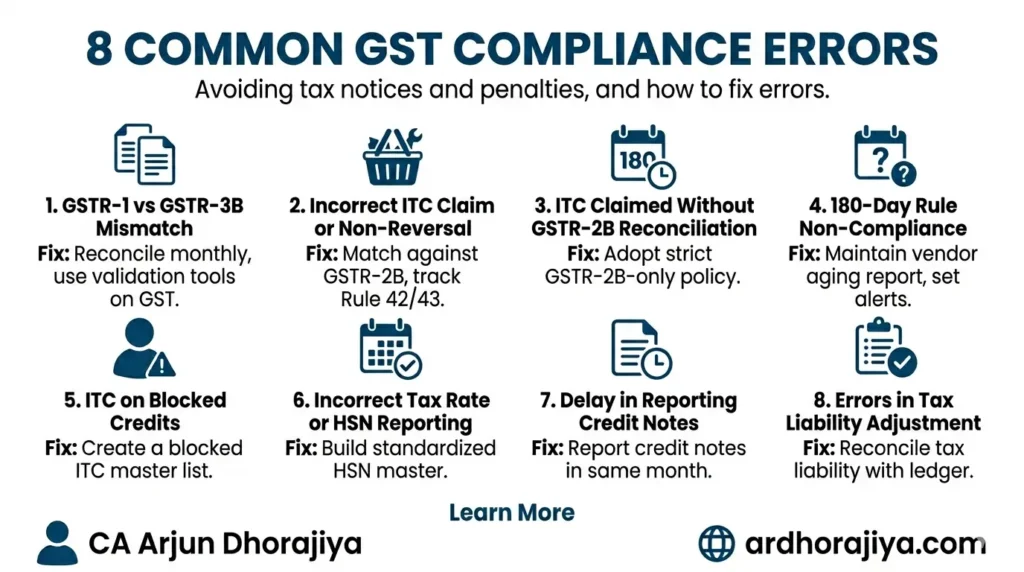
GST compliance errors are one of the biggest reasons businesses receive tax notices, pay unnecessary interest, and face penalties during audits. From GSTR-1 and GSTR-3B mismatches to incorrect Input Tax Credit (ITC) claims, even small reporting mistakes can have serious financial consequences. This article covers the 8 most common GST compliance errors, the legal provisions they trigger, and the practical steps you can take to fix them and prevent them from recurring.
Quick Reference: GST Compliance Errors at a Glance
Error Type | Key Provision | Risk | Fix |
GSTR-1 vs GSTR-3B Mismatch | Sec 37 & 39 | Notices, interest, GSTR-9 mismatch | Monthly reconciliation + GSTR-1A corrections |
Incorrect ITC Claim | Sec 16 + Rule 42/43 | Excess ITC, penalty exposure | Match with GSTR-2B; track vendor payments |
ITC Without 2B Reconciliation | Sec 16(2)(aa) | Disallowed ITC + interest | Strict 2B-only ITC policy |
180-Day Rule Violation | Rule 37 | ITC reversal + interest liability | Vendor ageing report + automated alerts |
Blocked Credit Claims | Sec 17(5) | Ineligible ITC claimed | Maintain blocked ITC master; periodic audit |
Wrong HSN / Tax Rate | Sec 37 + Rule 46 | Short/excess tax, notices | Standardize HSN master; rate checks |
Late Credit Note Reporting | Sec 34 | Turnover mismatch, excess tax paid | Report in same month; reconcile GSTR-1 |
Tax Liability Adjustment Error | Sec 39 + Sec 50 | Interest under Sec 50 | Review E-Liability Register before filing |
1. GSTR-1 vs GSTR-3B Mismatch
This is one of the most common GST errors and one of the most costly. GSTR-1 reports your outward supplies (sales), while GSTR-3B is your monthly tax payment summary. When these two returns do not match, the GST department flags it.
Why It Happens
- Invoices reported in GSTR-1 but not correctly reflected in GSTR-3B
- Credit notes or amendments not accounted for in GSTR-3B
- Clerical errors during data entry
Legal Provision
Section 37 governs outward supply reporting. Section 39 covers the filing of returns. Mismatches here directly affect your GSTR-9 annual return.
How to Fix It
Reconcile GSTR-1, GSTR-3B, and your books every month before filing. Use GSTR-1A to correct errors. The GSTN portal now mandates pre-filing validation, so make use of it to catch discrepancies before submission.
2. Incorrect ITC Claim or Non-Reversal
Claiming ITC you are not entitled to, or failing to reverse it when required, is a serious compliance risk. This includes claiming ITC on exempt supplies or personal expenses.
Why It Happens
ITC claimed on invoices for exempt or personal use
Rule 42/43 reversals for mixed-use assets not applied
180-day payment rule not tracked properly
Legal Provision
Section 16 defines eligibility. Rule 42 and Rule 43 prescribe the reversal formula for inputs used in both taxable and exempt supplies. Rule 37 covers reversal for non-payment to vendors.
How to Fix It
Match every ITC claim against GSTR-2B. Track vendor payment timelines. Apply Rule 42/43 calculations for proportionate reversal at the end of each financial year.
3. ITC Claimed Without GSTR-2B Reconciliation
Many businesses claim ITC based on their purchase register or vendor invoices without checking GSTR-2B. If the vendor has not filed their GSTR-1, that ITC will not appear in your GSTR-2B.
Legal Provision
Section 16(2)(aa), introduced via the Finance Act 2021, makes it mandatory that ITC is available only if it appears in GSTR-2B. Claiming ITC without this can result in demand notices and interest.
How to Fix It
Adopt a strict GSTR-2B-only ITC policy. Reconcile your purchase register with GSTR-2B every month. Follow up with non-compliant vendors and, if needed, hold payments until they file.
4. 180-Day Rule Non-Compliance
Under GST law, if you claim ITC on a purchase but do not pay your vendor within 180 days of the invoice date, you must reverse the ITC along with applicable interest.
Legal Provision
Rule 37 requires reversal of ITC in cases where vendor payment is pending beyond 180 days. Interest at 18% per annum applies from the date ITC was originally availed.
How to Fix It
Maintain a vendor ageing report and set automated alerts for invoices approaching the 180-day limit. Reverse the ITC in the relevant GSTR-3B filing and re-avail it once payment is made to the vendor.
5. ITC on Blocked Credits
Section 17(5) explicitly blocks ITC on certain categories of goods and services. Businesses often miss this and claim ITC on expenses that are simply not eligible.
Common Blocked Credits
- Motor vehicles used for personal purposes
- Food, beverages, and outdoor catering
- Club memberships and health club fees
- Health insurance (unless mandatory under law)
- Works contract services for construction of immovable property
How to Fix It
Create and maintain a blocked ITC master list. Improve your expense classification process so that finance teams can easily identify ineligible expenses. Conduct periodic ITC audits to catch and reverse incorrect claims before a GST officer does.
6. Incorrect Tax Rate or HSN Reporting
Applying the wrong GST rate or using an incorrect HSN code leads to short payment of tax, excess refund claims, or notices from the department. This is especially common for businesses with diverse product lines.
Legal Provision
Section 37 requires accurate reporting of outward supplies. Rule 46 mandates HSN-level disclosure on tax invoices. E-invoicing data must align with GSTR-1 entries.
How to Fix It
Build and maintain a standardized HSN master in your ERP. Use rate validation checks before invoices are generated. Cross-verify with e-invoicing data regularly to ensure all entries are consistent.
7. Delay in Reporting Credit Notes
When you issue a credit note to a customer, you are entitled to reduce your output tax liability. But if you delay reporting it, you end up paying more tax than required and create a mismatch in turnover.
Legal Provision
Section 34 governs credit notes. They must be reported within the prescribed time, typically the earlier of November 30 of the following financial year or the date of filing the annual return.
How to Fix It
Report credit notes in the same month they are issued. Maintain a sales return tracking register and reconcile GSTR-1 with your books at the end of every month.
8. Errors in Tax Liability Adjustment
Incorrectly setting off IGST, CGST, and SGST liabilities, or using the wrong ledger balance for payment, results in interest liability under Section 50.
Legal Provision
Section 39 governs return filing and the payment of tax. Section 50 levies interest at 18% per annum on delayed or short payment of GST.
How to Fix It
Reconcile your tax liability with your cash and credit ledger before filing GSTR-3B. Review the Electronic Liability Register on the GST portal to ensure all outstanding liabilities are correctly identified and paid.
Key Takeaways for GST Compliance
- Reconcile GSTR-1, GSTR-3B, and your books every single month without exception.
- Never claim ITC unless it appears in GSTR-2B. Follow up with vendors who are non-compliant.
- Maintain a vendor ageing report and track the 180-day payment window for all outstanding invoices.
- Build a blocked credits master list based on Section 17(5) and update it whenever the law changes.
- Standardize your HSN master and validate tax rates at the invoice generation stage.
- Report credit notes in the same month and reconcile turnover in GSTR-1 with your books.
- Always review the E-Liability Register before filing GSTR-3B to avoid interest under Section 50.
Conclusion
GST compliance is not a one-time activity. It requires consistent monthly action: reconciling your returns, matching ITC with GSTR-2B, tracking vendor payments, and validating HSN codes and tax rates before every filing. The eight errors covered in this article account for the majority of GST notices and interest demands that Indian businesses face today. By addressing each of these systematically, you reduce your compliance risk, avoid penalties, and build a cleaner audit trail. If you are unsure about any of these areas, consult a CA who can review your filings and help you course-correct before the annual return deadline.
You can call or whatsapp us on +91 9769647582 for GST filing queries or services.
Frequently Asked Questions
What is the penalty for GSTR-1 and GSTR-3B mismatch?
The GST department can issue a SCN (Show Cause Notice) and demand interest at 18% p.a. on the short-paid tax. Persistent mismatches can also trigger audits under Section 65.
Can I claim ITC if not in GSTR-2B?
No. As per Section 16(2)(aa), ITC is available only if it appears in GSTR-2B. You must follow up with the vendor to ensure they file their GSTR-1.
What happens if I miss the 180-day payment rule?
You must reverse the ITC claimed on that invoice under Rule 37 and pay interest at 18% p.a. You can re-avail it once the vendor payment is made.
Which expenses are blocked under Section 17(5)?
Motor vehicles (with exceptions), food & beverages, club memberships, health insurance (unless mandatory), and works contract services for immovable property are blocked.
How do I correct a wrong HSN code in GSTR-1?
You can amend the invoice details in GSTR-1A before the annual return is filed. Align corrections with your e-invoicing data to avoid future mismatches.
Serving across india
- Income tax
- GST
- Business registration
- Accounting
- Audit
- ROC filings
- Certificates
- Project report or CMA data